301 Moved Permanently
As the deployment of solar PV in the U.S. keeps increasing, greater attention is being focused on operations and maintenance (O&M) considerations, particularly for utility-scale plants - the dominant market segment in the country. The financing arrangements governing these multi-megawatt systems, often predicated on meeting production targets across 20 years, place a premium on sustaining plant health and lifecycle performance.
Yet O&M practices and protocols remain far from standardized, and as a result, associated budgeting is highly variable, if generally underfunded, according to a number of industry stakeholders.
The continual search for ways to reduce plant capital and operational expenditures is, for one, placing greater pressure on project stakeholders to streamline O&M practices and their accompanying costs. (Global system costs fell by 80% from 2008 to 2014, and utility-scale installations in the U.S. average about $1.69/W.) Typically considered a “cost center” on the balance sheet, O&M, even if recognized as a value input to a PV plant’s enduring welfare, tends to receive modest funding in order to satisfy competitive bid thresholds and/or stringent customer demands.
Record-low power purchase agreement (PPA) prices for utility-scale PV plants in the U.S. are intensifying scrutiny of project budgets, resulting in cuts to O&M, among other line items.
For perspective, average large-scale PV prices in the U.S. have dropped by roughly $25/MWh per year from 2006 to 2013 (~$226/MWh to ~$51/MWh) and by another $10/MWh in 2014, resulting in PPA prices in the Southwest that today fall below $40/MWh. The structural manner in which PV plants are developed, owned and operated is, meanwhile, a primary explanation for the observed variation in PV O&M approaches.
The motivations and self-interests of the actors that are financially invested in a plant over the course of its life span often assign differing degrees of importance to the O&M function - sometimes at the expense of a PV system’s cradle-to-grave financial outlook.
Due to divergent cost-benefit perspectives, there tends to be disagreement among involved parties about appropriate O&M funding allocations and the merit of including performance- or availability-based incentives into contractual language.
The relative scarcity of older PV systems installed in the field is a complicating factor further obscuring strategic thinking around O&M strategy and budgeting. The vast majority of PV plants installed worldwide have been commissioned within the last seven to eight years. Consequently, there is little long-term performance data available to analyze system operation and the effectiveness of concomitant O&M activities over multiple decades.
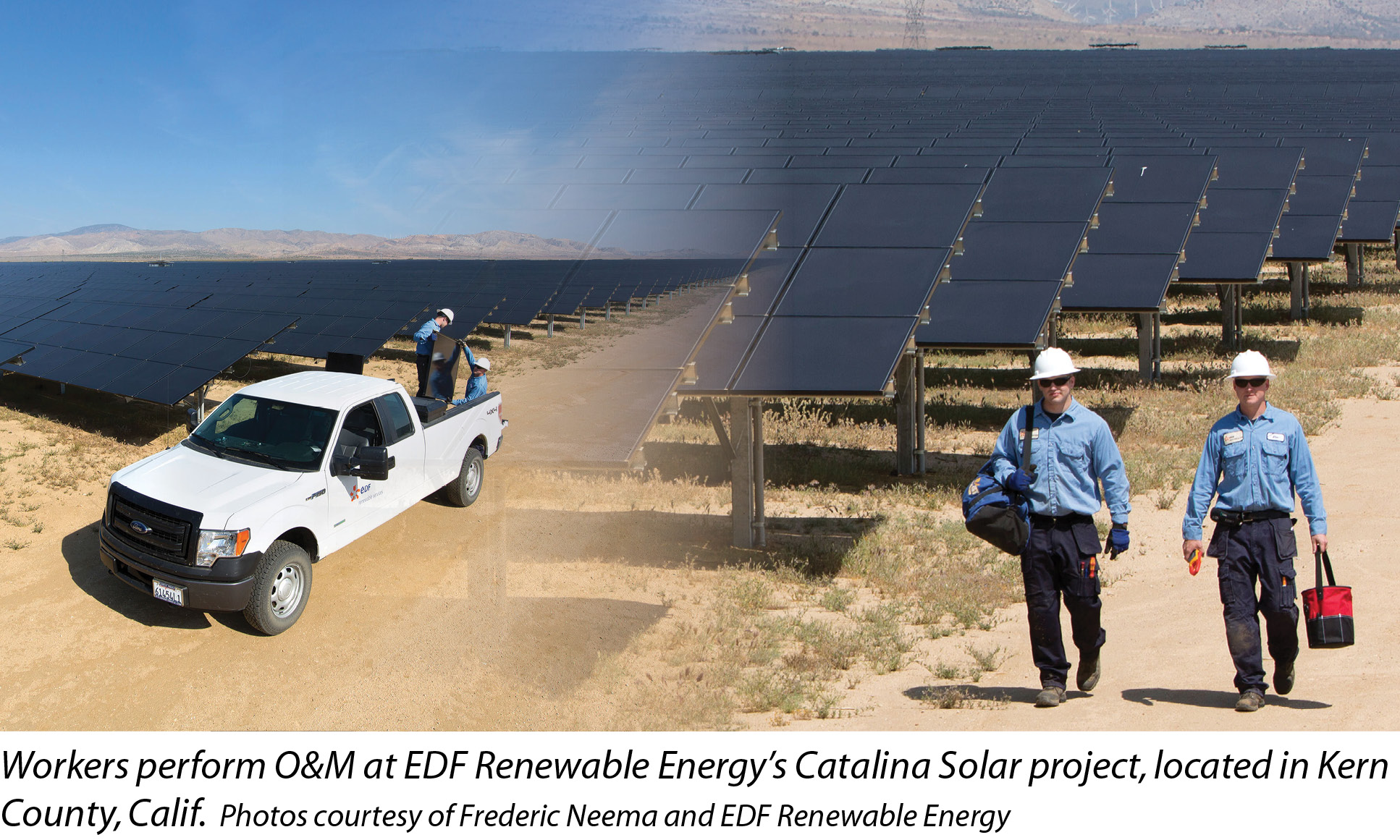
A constellation of companies inhabits, at least peripherally, the PV O&M space; each entity, however, has differing stakes in the outcome of a plant’s health due to the company’s primary and secondary roles in the market. For example, developers and engineering, procurement, and construction (EPC) firms are usually responsible for providing O&M as part of a service wrap, but they may seek to minimally budget for the activity if they intend to flip their projects to a new owner once tax credits have been fully tapped in five to seven years, or earlier.
Turnkey solar companies seeking to develop and manage their PV portfolios in perpetuity may invest more heavily in O&M, mindful of economy-of-scale savings that can be derived from effective fleet supervision. Meanwhile, O&M providers contract their services to meet explicit plant performance criteria at typically low margins, with some overcoming financially onerous EPC and/or plant owner demands by introducing “cost plus” and time and materials pricing to accompany flat-fee pricing for other services.
And insurers tend to advocate for relatively greater O&M budgeting to help guarantee long-term plant quality and reliability. (They are increasingly developing novel products to insure against plant revenue and production shortfalls, with pricing reflective of O&M risk perceptions.) These diverging attitudes about PV O&M impact budget allocations earmarked for that function. But a growing awareness of how O&M affects profitability means it now tends to be considered much earlier in the project development process than it has been historically, perhaps signaling the industry’s evolving thinking.
O&M approaches
O&M generally represents a small fraction of a plant’s lifecycle project development and operational costs. According to data collected through interview and survey, the activity typically accounts for between 1% and 5% of a megawatt-class plant’s total $/kWdc expenditure.
The wide range in data points is due to differing plant characteristics (e.g., size, design, equipment/components/moving parts, location), business interests and orientations, instituted O&M approaches with varying levels of rigor, and contractual arrangements (e.g., length, stipulated responsibilities, price structure). There simply is no one-size-fits-all approach to developing an O&M budget. Instead, a broad structure exists for guiding the budgeting process that is informed by multiple factors and attitudes.
That said, there is little consensus surrounding “appropriate” O&M budget levels. For example, O&M service providers tend to embrace higher budget requirements to cover their margins and contractual uncertainties, while developers are inclined to estimate lower O&M costs to increase plant valuations, and still other actors can be motivated to set O&M allocations based on individual project investment horizons and revenue prospects.
These contrasting viewpoints, among others, notify budget outcomes and can ultimately undermine a plant’s lifecycle performance economics. (An impartial independent engineering firm can help overcome budget biases.)
Stakeholders do, however, tend to agree that O&M budgets have historically been low and remain so, relatively speaking. The percentage of project budgeting allocated to the activity actually appears to be trending upward as capital costs continue to fall - but this is not necessarily resulting in more available dollars. That’s because an increasing number of companies are reportedly requiring that utility-scale PV plant EPC and O&M proposals be bid together, leading to sliding O&M prices caused by short-term (five-year) contracts with bidders that are motivated to exploit available warranties.
At bottom, budgeting is a variable cost-benefit exercise, informed by multiple perspectives, that attempts to balance O&M service levels and associated costs with the relative value afforded by enhanced performance and plant health. Though budget levels fluctuate across projects, structure and key decision vectors provide the organizing framework for rationalizing associated accounting.
PV O&M approaches are typically broken out into three main categories, each with different cost-benefit trade-offs and risk profiles:
- Preventive maintenance (PM) encompasses routine inspection and servicing of equipment - at frequencies determined by equipment type, environmental conditions and warranty terms in an O&M services agreement - to prevent breakdowns and unnecessary production losses. This approach is becoming increasingly popular because of its perceived ability to lower the probability of unplanned PV system downtime. However, the upfront costs associated with PM programs are moderate, and the underlying structure of PM can engender superfluous labor activity if not optimally designed.
- Corrective or reactive maintenance addresses equipment repair needs and breakdowns after their occurrence and, as such, is instituted to mitigate unplanned downtime. The historical industry standard, this “break-fix” method allows for low upfront costs, but it also brings with it a higher risk of component failure and accompanying higher costs on the back-end (perhaps placing a premium on negotiating extended warranty terms). Though a certain amount of reactive maintenance will likely be necessary over the course of a plant’s 20-year lifetime, it can be lessened through more proactive PM and condition-based maintenance strategies.
- Condition-based maintenance (CBM) uses real-time data to anticipate failures and prioritize maintenance activities and resources. A rising number of third-party integrators and turnkey providers are instituting CBM regimes to offer greater O&M efficiency. The increased efficiency, however, comes with a high upfront price tag, given communication and monitoring software and hardware requirements. Moreover, the relative novelty of CBM can produce maintenance process challenges caused, in part, by monitoring equipment malfunction and/or erratic data connection.
- Reliability-centered maintenance (RCM) and reliability availability and maintainability (RAM) can also be incorporated into O&M regimens. Both RCM and RAM rely on analysis results from fault and failure information collected from PM, corrective and CBM approaches applied to singular installations or fleets of plants.
On the whole, the PV segment is trending toward O&M approaches that promote greater oversight and management capability, and conventional approaches seem to be shifting from reactive to preventive maintenance approaches. However, CBM and reliability-centered strategies are anticipated to play a larger role as PV assets proliferate, associated information technology and deployment costs fall, and the overarching cost-benefit equation improves.
Regardless of the O&M approach implemented, the majority of associated contracts clearly delineate the defined activities to be performed, along with their frequency.

Budget development
The overriding process by which O&M budgets are developed and negotiated is not standardized, but it seems to follow a general pathway - one that could potentially benefit from institutional reform.
Often, the financing entity will dictate budget parameters based upon return-on-investment calculations and market drivers. These defined delimitations, however, are frequently developed independent of O&M plant needs and considerations.
Consequently, the contracted project EPC/developer can be forced, per communicated budget strictures, to shoehorn the numbers into a “workable” O&M plan. (Note, however, that some larger EPCs and turnkey development entities are beginning to more explicitly recognize the connection between plant design/configuration, construction and O&M. They are considering these issues earlier in the development process to more vigilantly inform O&M budgets.)
Taken a level further, O&M service providers and/or internal service divisions within EPC/turnkey development companies will typically negotiate with the project lead to clarify and define the scope of work (e.g., types and levels of service desired, frequency of site visits and activities, etc.) and associated expectations. During these contract negotiations, O&M providers estimate the budget according to either an all-encompassing price of service or a cost-plus model. (The industry is allegedly moving toward the latter.) Once negotiations are completed and the statement of work is agreed to, the budget is then formulated and relayed to the financing entity that underwrites the project (bank, financial group/investors, utility, etc.) for approval.
Though the O&M budget procedure is fairly finite, it produces a range of estimates that depend on project structure, investor expectations and, occasionally, the organization/design of the project bidding and request-for-proposals process. For example, seasoned turnkey solar development companies that self-perform O&M will incorporate specific budget levels based upon their organizational efficiencies, fleet experience and investment orientation.
Newer entrants will often rely on publicly available information or advice from peers to help set their budgets. Banks and lenders, meanwhile, will turn to independent engineering firms to provide them with budget recommendations. And insurers will also rely on third-party reports - or, alternatively, commission their own - to set policy prices that fluctuate based on the perceived adequacy of the O&M budget.
Separately, the manner in which projects are put to bid can impact O&M budgeting. For instance, one utility in California that outsources O&M services requires developer/EPC bids for all utility-owned projects to include a defined O&M budget. It, moreover, supplies bidders with a mandatory checklist of activities and activity frequencies (e.g., testing, visual inspection, etc.). This practice tends to depress O&M prices due to competitive bid pressures.
Re-imagining the process
Strategic reforms to mainstream PV O&M budgeting approaches - through the incorporation of both small and more far-reaching ideas - can help optimize O&M activities and, in turn, maximize financial returns. The solar industry appears to have made concerted strides in the servicing of PV plants over the last several years. But additional learning and tactical modification can likely further improve plant reliability at a cost that enhances the resource’s lifecycle competitiveness with other energy sources and a level of foresight that allows for future flexibility.
Industry stakeholders who were either interviewed or surveyed for this research effort voiced a number of “food for thought” recommendations for advancing PV O&M budgeting precepts. Some of these suggestions include the following:
Instill greater budget transparency. To some, O&M budgeting is improving due to greater recognition of site-related specifics and better definition of work scope elements. However, allowing independent O&M contractors and banks/insurers to review EPC budgeting to better understand how O&M and plant installation/commissioning are broken out would further improve coordination among stakeholders. Oftentimes, EPCs roll O&M into the overall installation cost, which can obscure the amount of actual budget apportioned to the activity. Rather than wrapping O&M into installation cost, it should be mapped to a statement of work to allow for more realistic budget allocation. (To more clearly stipulate service and cost expectations, most O&M providers are now using the cost-plus model.) Likewise, an O&M budget should be separated from commissioning so that service providers aren’t forced to perform commissioning on behalf of EPCs (essentially for free).
Align incentives along the value chain. The multiple actors involved in a plant’s development and upkeep have different incentives that can result in long-term owners being saddled with a low O&M budget that can compromise plant output and project success. Profit sharing represents a more involved structural budgeting reform for instituting O&M approaches that incentivize greater coordination among project stakeholders. Under this concept, if the cost of capital continues to decrease, the potential for higher margins offers an opportunity to reserve funds for incentivizing quality O&M or providing additional services. Because most contracts have liquidated damages clauses, there could arguably also be clauses for upside sharing and bonuses when targets are exceeded, for instance, akin to incentive distribution rights employed in some master limited partnerships. Today, the low cost capital only appears to be decreasing margins for O&M activities.

Evaluate and refine budgeting during initial years. Frequently, O&M requirements and associated funding needs are underestimated. Performing an analysis of site conditions over the first couple years of a project’s life and modifying the budget accordingly can mitigate shortcomings of initially instituted O&M strategies. Moreover, allowing for better estimates of maintenance costs once many of the initial warranties have expired would help improve pro forma cost estimates early in the project lifetime.
Require O&M review in independent engineering (IE) reports commissioned by lenders. In general, IE reports are customized to different client needs, and many do not contain a thorough review of a project’s O&M strategy. Although certain topics, such as energy production estimates, are commonly addressed, O&M is often overlooked; even when included, it represents a small sub-portion of the entire report.
Incorporate new approaches for determining service requirements to maintain component warranties. From a reliability perspective, the ability to aggregate plant performance across the U.S. to enable the identification of the top five O&M events would help improve the budgeting process and determine a reasonable availability guarantee that balances efficiency and cost with electric generation.
Consider decommissioning activities. Many owners do not budget for the decommissioning process. Due to lagging knowledge surrounding the costs of this activity, prices paid for the service may be higher than if there were greater competition. Decommissioning may include hazardous waste recycling, depending on the markets available for module and inverter recycling.
Standardization of various aspects of the budgeting process can potentially increase efficiencies and level set expectations. For example, standardizing on PV project components can lead to cost-competitiveness and lower prices paid for spares. (However, it is uncertain that parts standardization will lead to greater plant reliability if a plant’s complexity is consequently increased.) Moreover, standardizing procedures can lead to improved efficiencies for O&M technicians in the field. That said, standardization may work best if it is allowed to organically take root, rather than be forced on the industry.
Operations & Maintenance
Solar O&M Budgeting: How It Varies And Could Improve
By Nadav Enbar, Dean Weng & Geoff Klise
An overview of operations and maintenance for utility-scale solar projects.
si body si body i si body bi si body b
si depbio
- si bullets
si sh
si subhead
pullquote
si first graph
si sh no rule
si last graph