301 Moved Permanently
Community solar programs, with projects often called gardens, are emerging as an important new market for solar developers. The concept enables utilities and similar entities to support solar projects that not only reach customers who otherwise might be unable to consume solar power, but that also bring new investment into the market.
According to the Solar Electric Power Association (SEPA), community solar typically is a program through which individuals in an approved area have the opportunity to subscribe to a nearby solar installation, paying the owner an agreed subscription price and then receiving a percentage of the project’s output, either as a dollar value or in kilowatt-hours. The corresponding utility buys the energy from the solar garden and credits subscribers based on the approved rate.
The utility may be a large investor-
owned utility (IOU), a public power company or a private electric cooperative. SEPA identifies community solar programs of these varieties throughout the country, with many of these programs enabled by legislation.
Colorado may be considered the heartland of community solar along the IOU model, which is attracting the most interest from developers and investors because of the scale of the installations and corresponding number of subscriptions these enable. Recently, the Minnesota Public Utilities Commission approved a community solar garden proposal similar to Colorado’s successful model.
New model solar
When Xcel Energy launched the Solar*Rewards Community program in Minnesota in December 2014, it prompted a number of companies to capitalize on the concept and put long-standing plans into operation. In most of these cases, the companies had already performed a lot of the legwork required to hit the ground running.
David Wakely, director of communications for Minneapolis-based Minnesota Community Solar, says his company is just in the business of developing community solar projects and was formed solely for that purpose. He credits the state’s Clean Energy and Jobs Act passed in 2013 with creating a brand-new business model for solar that essentially enabled a vast new customer base.
“Not only are we taking advantage of the business climate, we are talking about something that brings capital to the table that the utility itself wasn’t necessarily going to access,” Wakely says. “We have customers coming in with what is essentially new money to build new electric generation and to free up places on the grid where, frankly, no other kind of generation could go.”
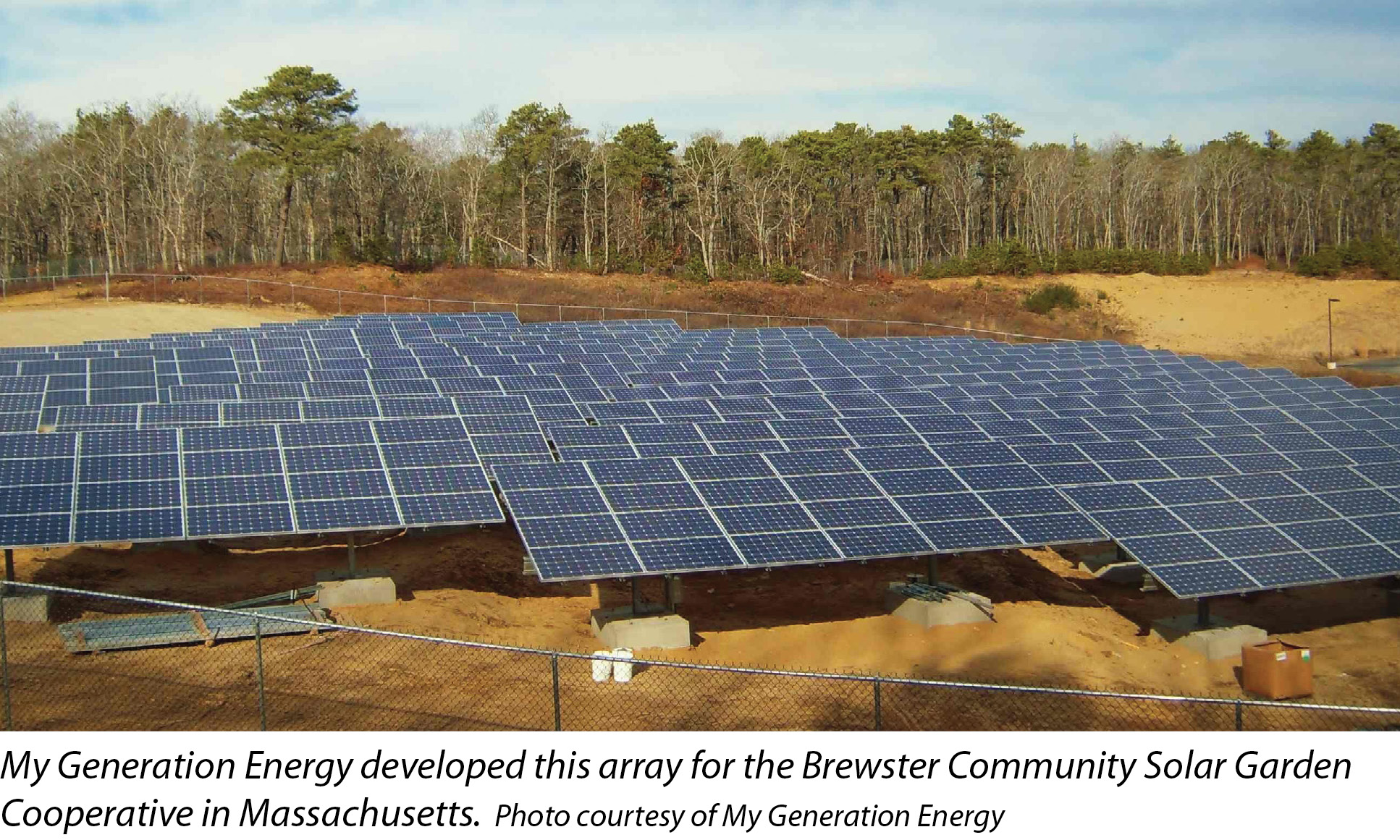
In terms of its mechanics, a community solar array is typically a ground array or large-scale roof mount that is close to an interconnection. The developer pays the land owner to host the site and recruits subscribers who pay for the electricity being produced by the array. The utility benefits by having the opportunity to approve the community solar projects in its service area and is, thus, able to select those projects that have favorable interconnection characteristics.
From Wakely’s perspective, community solar is addressing customers who otherwise would be unable to consume solar power. The potential of this untapped market is attracting developers whose projects would otherwise not be built without the community solar mechanism in place.
“We have a solar array in Gaylord, Minn., right between a food processing facility and a wastewater treatment plant, just a couple of miles outside the main square in town,” he says. “You can’t put a coal plant or a nuke plant there. There are efficiencies for the utility as well, insofar as they are not losing anything to transmission. This kind of distributed generation brings fresh capital to the table, both on the investor side and on the subscriber side.”
Dana Hallstrom, subscription manager for Minnesota Community Solar, says the business model requires some specialization on the part of developers. For one thing, community solar companies need subscription managers.
Minnesota Community Solar sells 25-year subscriptions to its energy projects. The subscriptions are transferable if the individual moves within the approved service area, which is generally the county in which the solar site is located or an adjacent county. Moreover, the subscription may be transferred to another party or even put in the subscriber’s will.
“Managing these customer relationships is an important aspect of making sure the solar garden remains secure and stable financially,” Hallstrom says. “That’s not something that Xcel is going to do.”
New partnerships
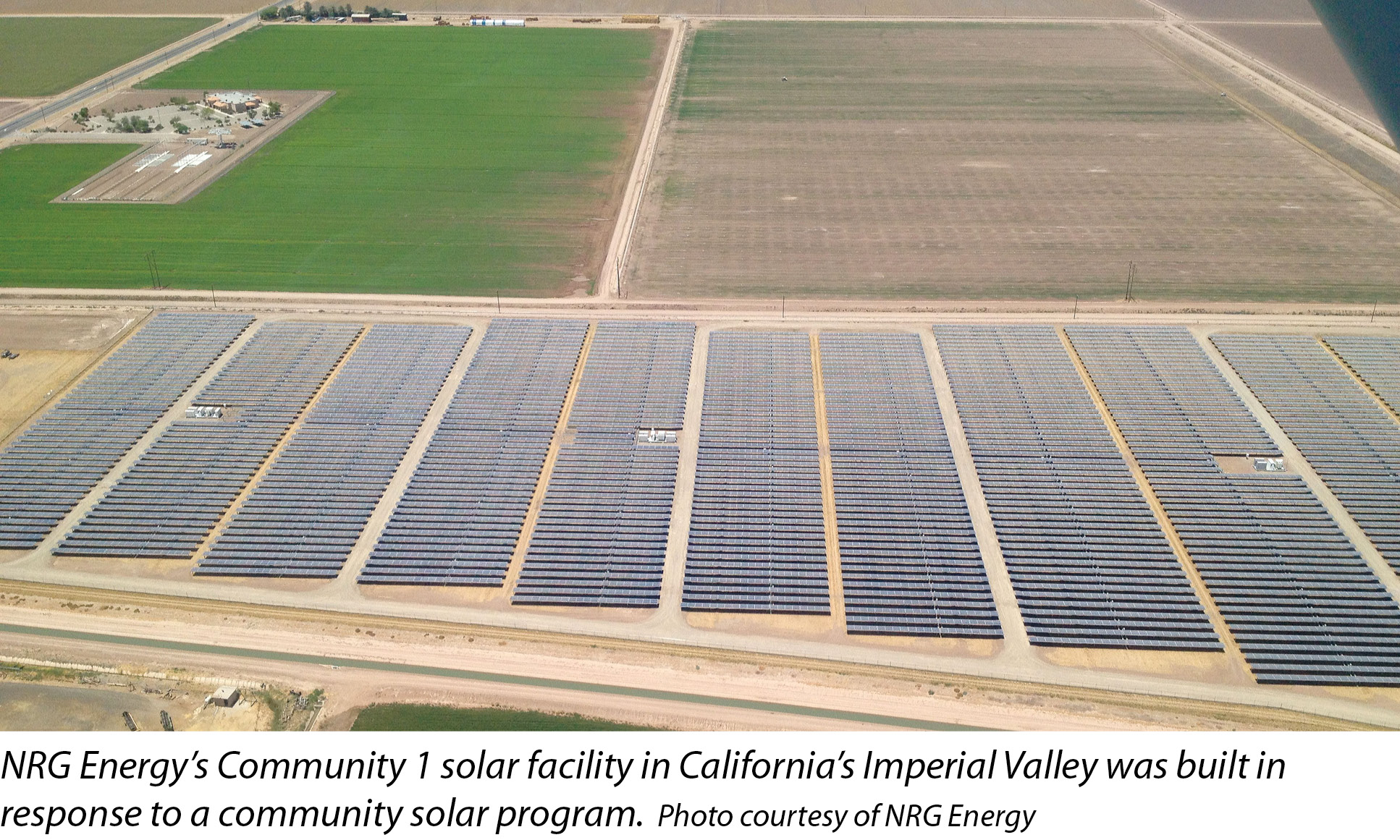
The prospect of new business from community solar has generated significant interest from diversified energy companies looking to benefit from the model. NRG Renew and SunShare have partnered to finance and build 10 MW of community solar projects in Colorado. The five projects include four in Xcel’s service area near Denver and one for the municipal Colorado Springs Utilities. All are ground-mount tracking projects.
SunShare has the five projects under development and will assume responsibility for customer management, subscriptions and billing. NRG Renew is providing funding and construction and will be responsible for the physical aspects of the plants, including operations and maintenance services and asset management. SunShare and NRG will have joint ownership of the projects, which are expected to be online by the middle of the year. Both companies see a tremendous future in community solar.
David Amster-Olszewski, CEO of SunShare, says that as the Colorado Public Utilities Commission worked to craft the rules that would govern the projects operating under the state’s community solar gardens law, his company made its first move with the Colorado Springs Utilities.
“The municipal utility in Colorado Springs was able to write its own rules without having to go through a lengthy public utilities process,” Amster-Olszewski says. “This enabled us to pilot the model. Then, we moved into the Xcel market in the more populous areas around the Denver area once those programs opened up.”
SunShare is moving aggressively in the community solar market. Earlier this month, the company formed a partnership with Minneapolis-based construction firm Mortenson to build community solar projects in Minnesota.
For its part, NRG Renew, a wholly owned subsidiary of NRG Energy Inc., sees its partnership with SunShare as an important aspect of its goal to deliver renewable energy for consumers across the full spectrum of scale and location.
Craig Cornelius, senior vice president of business development at NRG Renew, says community solar represents a substantial market of financeable commercial and industrial (C&I) and residential retail customers that want to adopt solar but cannot due to site-use limitations.
“We think the fact that regulators and legislators have helped create a market and regulatory construct that allows those types of consumers to adopt solar is great news for the country,” Cornelius says. “The opening of this market segment is pretty revolutionary, and we’d like to be there first.”
According to Cornelius, the successful adoption of community solar in Colorado, Minnesota and elsewhere - followed by capital and the construction of projects - is hopefully going to drive a significant acceleration of the segment nationwide. “There’s no greater encouragement to utility commissions and legislators than to see programs working and meeting their objectives in other states, right?”
That a heretofore niche market segment is attracting financing and services from a heavy-hitter like NRG is an indication that community solar’s time has come. Amster-Olszewski says SunShare’s partnership with NRG Renew is a signal the concept is mainstream, which will attract more capital and regulatory clarity in other states.
“I think community solar, at the end of the day, is going to dwarf the utility, residential and C&I solar market segments,” he says. “It combines the lower cost of large commercial and utility-scale development with the customer choice, engagement piece that you have with small commercial and residential. Putting those pieces together is going to be powerful.”
Industry At Large: Community Solar Gardens
Community Solar Programs Open New Doors For Developers And Consumers
By Michael Puttré
Community gardens are widening access to solar while attracting new capital into the sector.
si body si body i si body bi si body b
si depbio
- si bullets
si sh
si subhead
pullquote
si first graph
si sh no rule
si last graph