301 Moved Permanently
A year ago, DNV GL acquired California-based PV Evolution Labs (PVEL), a provider of PV solar module technical due diligence testing services. Jenya Meydbray, former CEO of PVEL, now heads up DNV GL’s solar product qualification and testing efforts and is working on a white paper on photovoltaic module degradation, including potential induced degradation (PID).
Solar Industry asked Meydbray and Ray Hudson, DNV GL’s global solar service leader, about the current state of PV module testing and what new technologies module manufacturers are bringing to the table.
SI: As an engineering and testing firm, have you developed any ideas about what causes PID in modules and how you can evaluate PV systems for it?
Jenya Meydbray: When PV modules are deployed in the field, they are wired up in series. You plug the first one into the second one into the third one and so on until you achieve your string voltage. When you get to the last module in the string, you have a fairly large voltage potential between the frame and the cell.
The leading theory for the cause of PID is that the glass used in the PV industry is very standard, low-iron soda lime glass. Soda lime glass has mobile sodium ions in it. When you put a voltage potential across that piece of glass, you can pull those sodium ions out. Depending on the polarity, or voltage, the ions will either go out toward the sun or in toward the cell.
Sodium is salt, so if the salt comes out toward the air, you can actually salt along the frames over time. If it goes in toward the cell, sodium ions penetrating through the front surface of the cell can be damaging. There are various techniques to get around this effect. Some manufacturers try special encapsulants that have a sodium-blocking layer. Others try engineering the front surface of the cell to reduce its sensitivity to PID. We’ve seen both be successful. And we’ve seen both not be successful.
Ray Hudson: Some manufacturers advertise their modules as being PID-resistant, and of course, you have to look at the testing and details that were done to support that.
A big part of DNV GL’s solar business is performing advisory services for solar power plants. In those cases, we are reviewing the entire system representing either the financier or the developer as an independent engineer. Our job is to review the system and perform energy estimates with the idea of ensuring that the plant will perform technically and financially as expected.
On the system side, we’ve reviewed thousands of systems over more than 10 years. So, in addition to working with a lot of manufacturers, we get to work with a lot of developers and see a lot of things actually in the field.
For PID, we make special reviews for the items that have been identified as being important, including the system voltage, the grounding configuration and the inverter that’s used. Of course, the modules and even the environment at the site, such as temperature and humidity, are part of what causes PID.
We have spent a lot of time reviewing systems in the field. Whether this is for potential performance issues or just because the project is going to be sold to a new owner and we’re reviewing it, we’ve got to go out and see projects, including some where PID has been an issue. So, we’re building up field experience on that.
SI: What is the role of an independent testing firm like DNV GL versus testing done by standards organizations?
Meydbray: When it comes to testing, there is regulatory testing and market-driven testing. DNV GL is focused on the market-driven side. The regulatory testing involving the Underwriters Laboratories (UL), Intertech and others is in response to a standard that has been written by UL, the International Electrotechnical Commission or some other standards body. They execute the testing program per the letter of the standard, issue a certification or test report based on the performance of the product, and then hand that report over to the manufacturer, which can do what it wants with it.
All modules that are in the U.S. market have UL 1703 certification. That’s not a differentiator. That’s a minimum bar just to participate in the market. Beyond the simple pass/fail binary of the minimum bar, there is a large spectrum of performance and reliability. Our clients typically want to focus on the equipment that is higher performing with higher reliability and can demonstrate that through testing results while maintaining an attractive price point to keep the project’s economics viable.
The regulatory standards move very slowly. They don’t evolve at the fast pace that the industry moves at. The market needs testing that is above and beyond and more nimble than the certification standards can provide. We have 50-plus manufacturer clients and 90 downstream partners. We are constantly talking to all of these players to understand which direction the industry is moving in and to try to develop tests that can be beneficial to folks who are making big decisions.
As part of the qualification program, PID is one of the tests that is performed. There are a number of concerns that large buyers and investors have when evaluating equipment. On the module side, there is the robustness of the package - how does the module stand up to the elements in terms of humidity, temperature changes, ultraviolet exposure and the various stresses that happen up on your roof or out in the desert.
Hudson: Part of our service is to perform a design review of the system and to review the components. We view certification as the bare minimum of what you need. That’s the starting point. Effective third-party testing is needed and beneficial.
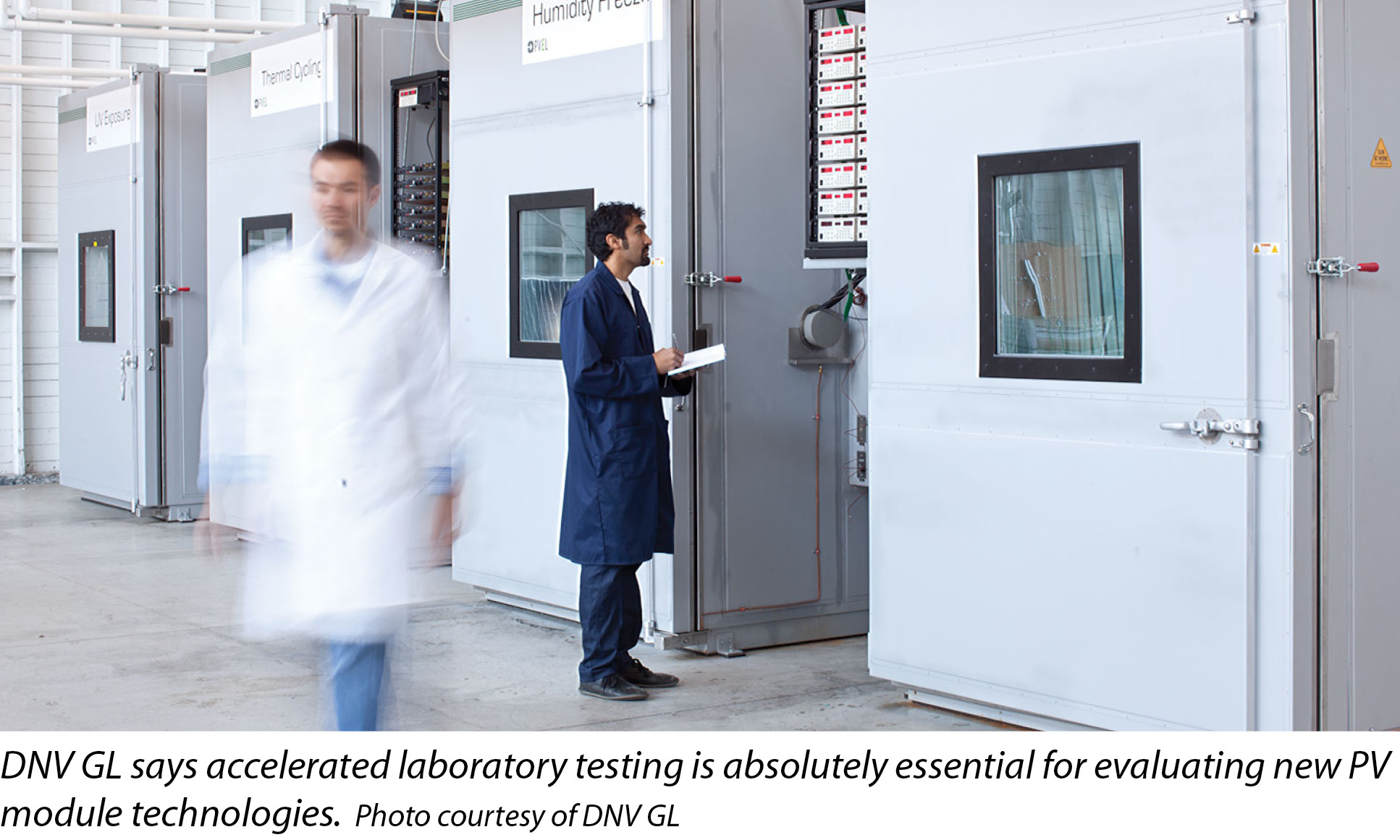
DNV GL has both extensive laboratory capabilities at its facilities in Berkeley and also a range for outdoor environmental testing at the PV USA site in Davis, Calif., where there’s a lot of history and a lot of equipment that’s seen a lot of time in the sun.
SI: How do you design your laboratories testing procedures so that they represent real-world PV power systems over time?
Meydbray: There are two sources of data: Real-life data and laboratory data. Both have their limitations. The testing that we perform in an accelerated laboratory test environment is not exactly a perfect representation of a solar plant.
However, the data that one gets from actual plants often involves outdated equipment. The products have moved on. The bill of materials are different, the manufacturing processes are different, and the products even look different. So, although all the field data is really instructive and beneficial for drawing conclusions about long-term PV performance, this is not as useful for understanding how today’s commercial products perform, especially relative to one another.
You have to use laboratory testing. There is no other way to do it. The science of how you do accelerated long-term testing for PV modules does have a 30- to 35-year history. It’s certainly not perfect. You cannot measure how much something will degrade or calculate the exact usable life. You can’t take a measurement on a module and say, “This is a 27-year product.”
SI: You say that laboratory testing is necessary to properly evaluate new module technology. Is there a lot of new module research coming online, given how low prices have gotten?
Meydbray: Folks are not done doing module research and development. We’re still seeing a lot of new innovation still happening on the module side. I’d actually say that we are seeing a second uptick of module technology starting now. It kind of died down with all the companies in Silicon Valley essentially going bankrupt. But, we’re seeing a second wave happening now.
As PV penetration increases in certain utility areas, there are more stringent requirements on how the systems interface with the grid. One result of this is that we’re seeing a lot more electronics in modules. This is not ubiquitous, yet. But all of the major manufacturers are playing with some version of that - some sort of electronics integrated into the modules.
On that point, the price of PV modules plummeted over the past couple of years. That trend has sort of leveled off, and folks are looking at cost reduction in other parts of the system.
Hudson: Innovation is certainly not over. It is continuing. One of the things we review is total system aspects of an installation. I think you will get to where some additional costs are put into the components - modules and inverters, for example - that reflect a benefit to the rest of the system.
On the electrical side, the move by some manufacturers to develop products that support 1,500 V systems is an example of putting some additional electrical margin - certainly, installation margin - into the modules, and the benefits flow to the rest of the system in that you achieve lower balance of system costs through cables and inverters.
In general, you see higher voltages and higher efficiency at lower costs of energy.
Meydbray: That is one innovation that when I talk to my downstream partners, they are all asking for it. Who can do 1,500 V modules? We have a 100 MW system that would become a lot more economically attractive if we could use those.
A lot of these innovations are being driven from the downstream side. There’s a lot of pull from that.
Hudson: This ties into the conversation about PID because higher voltages have the potential to be a larger cause of, or to have greater influence on, PID.
Marketplace: PV Modules
DNV GL Takes On Module Degradation In Lab And Field
By Michael Puttré
A year after acquiring PV Evolution Labs, the testing and certification firm says PV module research is picking up.
si body si body i si body bi si body b
si depbio
- si bullets
si sh
si subhead
pullquote
si first graph
si sh no rule
si last graph